
The Invisible Threat: How One Physicist's Fight Against Free Radicals Revolutionized Orthopedic Implant Safety
A deep dive into the pioneering work of Dr. Muhammad Shah Jahan, whose research into free radicals transformed the safety and longevity of orthopedic implants.
The Invisible War on Wear:
Extending the Life of Medical Implants
How Dr. M. Shah Jahan's fight against free radicals revolutionized orthopedic implant safety.
E very year, millions of people worldwide undergo a modern medical miracle: hip and knee replacements. These procedures restore mobility, relieve chronic pain, and allow seniors to return to active lives—hiking, dancing, and playing with grandchildren.
However, for decades, a hidden enemy threatened the longevity of these life-changing devices. It was an invisible problem occurring at the molecular level, and it took the lifelong dedication of Dr. M. Shah Jahan at the University of Memphis to make it visible and, ultimately, solvable.

Fig 1: Ideally, joint replacements allow patients to return to active, happy lives. But ensuring those implants last a lifetime requires mastering molecular science.
The Double-Edged Sword of Safety
Most modern joint implants use a plastic component made of Ultra-High Molecular Weight Polyethylene (UHMWPE). Before these implants can be implanted into a patient, they must be absolutely sterile.
To ensure patient safety, manufacturers use terminal sterilization, often involving gamma irradiation. While this process is incredibly effective at killing bacteria, it comes with a hidden cost. The high-energy radiation that protects the patient from infection simultaneously attacks the implant's core material.

Fig 2: The modern hip implant relies on biocompatible materials, but sterilization can compromise their long-term stability.
Molecular Rust: The Problem of Free Radicals
When radiation hits the polymer chains of an implant, it knocks out electrons, creating "free radicals". These free radicals are highly reactive and unstable.
Think of it as "molecular rust". Over time, these radicals attack the long polymer chains that give the plastic its strength. This process causes the chains to break (scission) or bond incorrectly (cross-linking), weakening the implant from the inside out. The result? The plastic degrades, wears out faster, and can lead to premature implant failure and the need for painful revision surgeries.

Fig 3: Like molecular rust, free radicals degrade the integrity of the implant material, leading to premature failure.
Making the Invisible, Visible
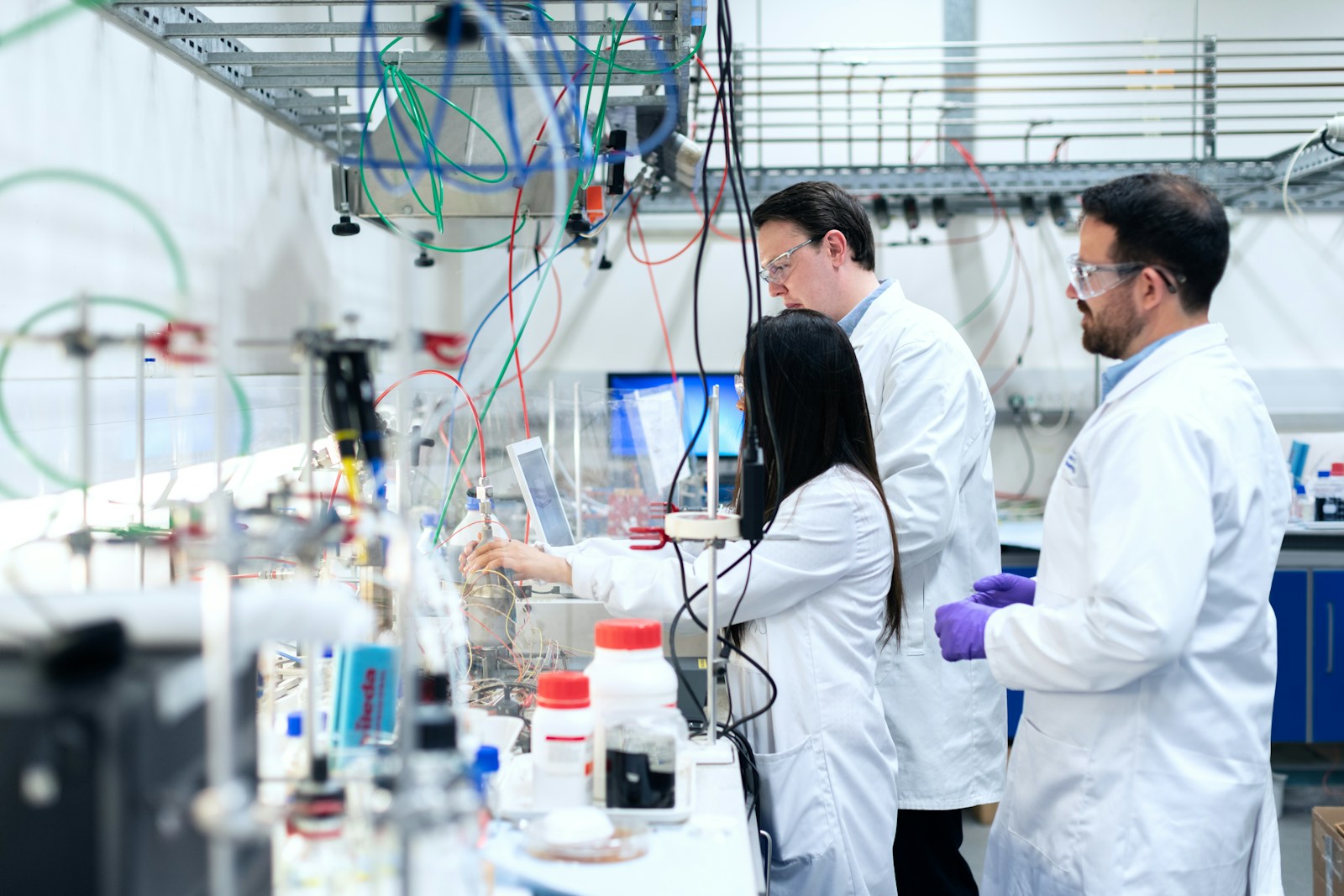
The challenge for the medical industry was that free radicals are invisible to conventional analysis methods. You cannot see them with a standard microscope. This is where Dr. M. Shah Jahan stepped in.

Fig 4: Dr. M. Shah Jahan, a physicist at the University of Memphis, dedicated nearly 40 years to understanding free radicals in biomaterials.
A Professor of Physics at the University of Memphis for nearly four decades, Dr. Jahan applied a powerful technique called Electron Spin Resonance (ESR) spectroscopy.
ESR is unique because it can directly detect the "fingerprint" of free radicals. By placing an implant sample in a strong magnetic field and applying microwave energy, the free radicals absorb energy and emit a specific signal. This allowed Dr. Jahan not just to see that radicals were present, but to quantify exactly how many there were.

Fig 5: Using Electron Spin Resonance (ESR), Dr. Jahan’s lab could detect the unique magnetic "fingerprint" of free radicals.
Transforming an Industry
Dr. Jahan’s Biomaterials Research Laboratory at the University of Memphis became a global hub for orthopedic safety. His mantra was simple: "If you can measure it, you can manage it".
Major industry leaders—including Smith & Nephew, Zimmer Biomet, and Stryker—collaborated with Dr. Jahan to test their products. By using ESR analysis, manufacturers could finally compare different sterilization methods scientifically. They used Dr. Jahan's data to validate new manufacturing processes that dramatically reduced or eliminated residual free radicals.

Fig 6: Dr. Jahan's work enabled manufacturers to move from standard irradiation to optimized processes, drastically lowering free radical concentrations.
A Legacy of Longevity
The impact of this research is felt by patients every day, even if they never know Dr. Jahan's name. Because of his work in identifying and measuring this threat, modern implants are significantly less susceptible to oxidative degradation.
For the patient, this means:
- Reduced risk of premature wear and failure.
- Fewer costly and painful revision surgeries.
- More years of active, healthy mobility.

Fig 7: The legacy continues. PhD candidate Afsana Sharmin uses ESR technology to research the next generation of implant safety.
"If you can measure it, you can manage it."
By bridging the gap between fundamental physics and patient reality, Dr. Jahan helped redefine the lifetime of an implant, turning a medical device into a true lifetime companion.
About the Author & Researcher
Dr. Muhammad Shah Jahan
Professor of Physics / Researcher
Dr. Jahan dedicated nearly 40 years to understanding free radicals in biomaterials at the University of Memphis. His legacy continues through the generation of scientists he trained, who continue to use ESR technology to research the next generation of implant safety.
